By Iris Elliott and Phuong Diep
Across Ontario, Work-Integrated Learning (WIL) is becoming one of the most important bridges between education and employment. As technologies shift, industries evolve, and learners seek clearer pathways into meaningful careers, WIL has become a powerful tool for connecting classroom learning to real world application. But it is more than a placement, internship, or project. WIL is shaped by the players: students, postsecondary institutions, employers, governments, and conveners who work together to create meaningful, quality learning experiences that expand into knowledge, skill, and labour transfer from postsecondary institutions (PSI) to industry.
This post opens a three-part series exploring WIL in Ontario. We begin with the big picture: what WIL is, why it matters, how the ecosystem works, and propose a Hierarchy of Needs of the players in this sector that can help us understand the pressures and priorities shaping the system today.
Why WIL Matters
WIL has become essential to workforce development in Canada, strengthening the talent pipeline and deepening collaboration. According to the Business + Higher Education Roundtable (BHER), WIL projects are most successful when they are embedded into the long-term operations of employers and institutions, becoming part of their talent development and innovation pathway infrastructure.
WIL matters because:
- Students gain experience that turns tacit abilities into explicit, demonstrable skills.
- Employers access talent, fresh ideas, and innovation capacity.
- Postsecondary institutions build stronger academic-industry connections that enhance curriculum and research.
- Governments and funders support pathways that strengthen employment outcomes, productivity, and national innovation capacity.
Over the past decade, funding programs have played a major role in scaling WIL in Canada. The current funding landscape includes many programs. The Student Work Placement Program (SWPP) provides wage subsidies for employers hiring PSE students. CEWIL Canada’s WIL Innovation and VIRTEX grants support PSE WIL programs. Mitacs Accelerate offers $15,000 in funding for research-based internships and community partnerships. The Mitacs Business Strategy Internship provides $10–15,000 for innovation-focused capacity-increasing business projects. The Ontario Co‑operative Education Tax Credit refunds up to $3,000 in eligible student hiring expenses. These programs can help reduce financial barriers and enable employers — especially resource-constrained SMEs — to host students.
WIL at eCampusOntario
eCampusOntario has a long history of supporting and scaling WIL across higher education. We work with the following partners to grow access to and design of high quality WIL experiences:
- Business Higher Education Roundtable (BHER) and Mitacs to expand connections and opportunities between post-secondary education institutions, students, and businesses.
- ICTC and Magnet to provide SWPP funding to SMEs hiring work-integrated learning students at our Ontario member institutions. Your business or organization may be eligible to receive 70% (up to $7,000) in wage subsidies to reduce the cost of hiring and test-driving new skills.
- Tech Access Canada, where we are helping to support student teams working on industry-led projects at Tech Access Centres across the country. This initiative is providing support for 275 WIL experiences and connecting more than 50 employers to work-integrated learning.
Connect with us at wil-ait@ecampusontario.ca to learn more!
What is WIL and Who Is Talking About It
CEWIL Canada defines WIL as:
“A form of curricular experiential education that formally integrates a student’s academic studies with quality experiences within a workplace or practice setting… involving an engaged partnership between an academic institution, a host organisation, and a student.”
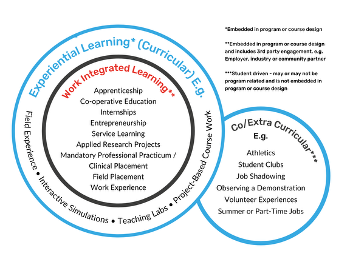
This definition highlights three essential points:
- WIL is curricular: it works best when it is intentionally positioned, not incidental.
- It is co-created: by institutions, employers, students, government and convenors.
- Quality matters: successful WIL must support learning outcomes, reflection, and assessment, all of which must be intentionally designed.
The ecosystem around WIL is active and growing. Bodies such as CEWIL Canada, BHER, ICTC, regional networks, and sector-specific groups continue to research, evaluate, and advocate for effective WIL models. These organisations consistently identify WIL as a mechanism for scaling innovation, reducing skills mismatches, and helping young people access meaningful careers.
Who Is Involved and What Matters to Them
The WIL system is built on interconnected roles. ICTC’s national research describes the core players succinctly:
- Postsecondary Institutions (PSIs) deliver curriculum, assure quality, and build trusted relationships with employers.
- Students seek paid, mentored experience that leads to employment and career clarity.
- Employers need quick access to the right skills, low friction onboarding, and real value from student contributions.
- Funders and governments aim to reduce unemployment, strengthen innovation capacity, and accelerate pathways from research to market.
- Convenors, like eCampusOntario, BHER, Future Skills Centre and others, help surface PSI offerings, connect employers, standardize quality, and reduce the administrative burden on all sides.
Each player has distinct needs, pressures, and incentives which influence how WIL is designed, delivered, and experienced.
A Hierarchy of Needs for the WIL Ecosystem
A hierarchy of needs helps us understand the interconnected priorities, constraints, and influences shaping the WIL system. By mapping what each stakeholder requires to succeed, we can better identify innovation opportunities, design better solutions, and focus our efforts on the areas that matter most.
Here is the Hierarchy of Needs we developed for Ontario’s WIL players:
Hierarchy of Needs & Influence in the WIL Ecosystem
| Player | Highest Needs | Other Needs |
|---|---|---|
| Funders (e.g. Government) | Lower unemployment; Develop stronger national innovation capacity and sovereignty | Move research toward commercialization; Align opportunities to labour market demands and timing (e.g. create incentives like funding or policy changes, ISED streams, SWPP); Be transparent with rules and processes |
| Institutions (PSIs) | Bridge programs and research outputs to labour market outcomes; secure sustainable WIL partnerships; achieve 100% placement targets where program requires | Align postings to program learning outcomes; share opportunities equitably; facilitate communication and match between engaged employers and students; help students achieve a good WIL experience |
| Students | Convert experience into interviews, offers, and career clarity | Gain exposure to industry; turn tacit skills into explicit competencies; build a mentor-supported network preferentially through paid WIL |
| Employers | Quick access to skills and labour; Build a talent pipeline; integrate student talent and PSI knowledge into innovation and growth and company sustainability | Support students to contribute to the business needs; Simple wayfinding to connect with compatible PSI programs (especially for SMEs); Trust in quality and match of student to work |
| Convenors (such as BHER, CEWIL, eCampusOntario and peers) | Reduce duplicating efforts across institutions and employers by scaling and sharing best practices; Create and offer thought leadership and aggregation of tools, standards, and supports such as templates for scoping, mentoring, and assessment | Act as the nexus that brings people, ideas, and resources together to broaden opportunities |
Understanding these layers supports better decision making. It can reveal friction points (e.g., administrative load, timing mismatches, uneven access to opportunities), but also opportunities, especially where convenors and funders can reduce transaction costs and lift quality systemwide.
Power and Influence in Context
Each player in the WIL ecosystem has influence, but not always in the places they most feel pressure.
- Students carry the least formal power, yet WIL experiences disproportionately impact their life outcomes, and they are a very important vector for the knowledge and innovation transfer and generation.
- Employers bring the projects and jobs that make WIL possible, but connecting with the right PSI channels and navigating program requirements can be difficult, especially for SMEs with limited resources who may be navigating the process less regularly to match their vacancy needs.*
- PSIs are responsible for student experience and curricular integrity, but rely on employers and funders for opportunity.
- Funders shape the system strongly through incentives and timing yet rarely interact directly with students or day-to-day WIL operations.
- Convenors sit in a unique position, with visibility across institutions and employers, but rely heavily on collaboration to enact change.
Recognizing these interdependencies helps us build WIL systems that are not only larger, but more equitable, sustainable, and impactful.
*Unlocking SME Potential in WIL
While larger firms often have established rhythms and resources they can dedicate to aligning resource requests with PSE timelines, SMEs make up approximately 99.6% of businesses within Canada (numbers from 2023). SMEs represent an enormous source of potential and innovation within WIL. Despite offering meaningful, high‑impact learning opportunities for students, many SMEs face access challenges due to limited administrative capacity, time, and resources needed to engage in WIL programs. As a result, their ability to participate fully isn’t based on lack of interest, but on structural barriers that convenors and partners can help address.
Our interviews revealed that unlocking these SME connections is a potential key to strengthening the WIL ecosystem. The next two posts in this series will explore what we learned from SMEs directly, what they need, where they get stuck, and how better designed pathways could dramatically expand their participation.
Add Your Voice
This series is meant to open a sector-wide conversation, and we want to hear from you. Please share your experiences, solutions, and questions — they will help shape shared tools, guidance, and support for best WIL practices. Together, they aim to spark collaboration and help build a stronger provincial WIL ecosystem.
What’s Next in This Series
This is the first of three posts exploring Ontario’s WIL landscape:
- Setting the Stage (this post)
- What Ontario PSIs Are Doing: Sector Stories
- SMEs and WIL: Matching Business Milestones to WIL
Equity, Diversity, Decolonization, and Inclusion (EDDI) Acknowledgement
The insights in this first post are informed by early conversations with colleges and universities and employers across Ontario, with a strong representation from urban institutions. We recognise that to understand WIL in its full complexity, we must meaningfully include voices from Indigenous Institutes, French and bilingual institutions, and other communities not yet fully represented in our consultations. This work is ongoing, and we welcome all who wish to contribute in the comments or by reaching out to us directly (research@ecampusontario.ca).