
What the 3rd Franco‑Ontarian Forum Reveals About the Future of Francophone Postsecondary Education
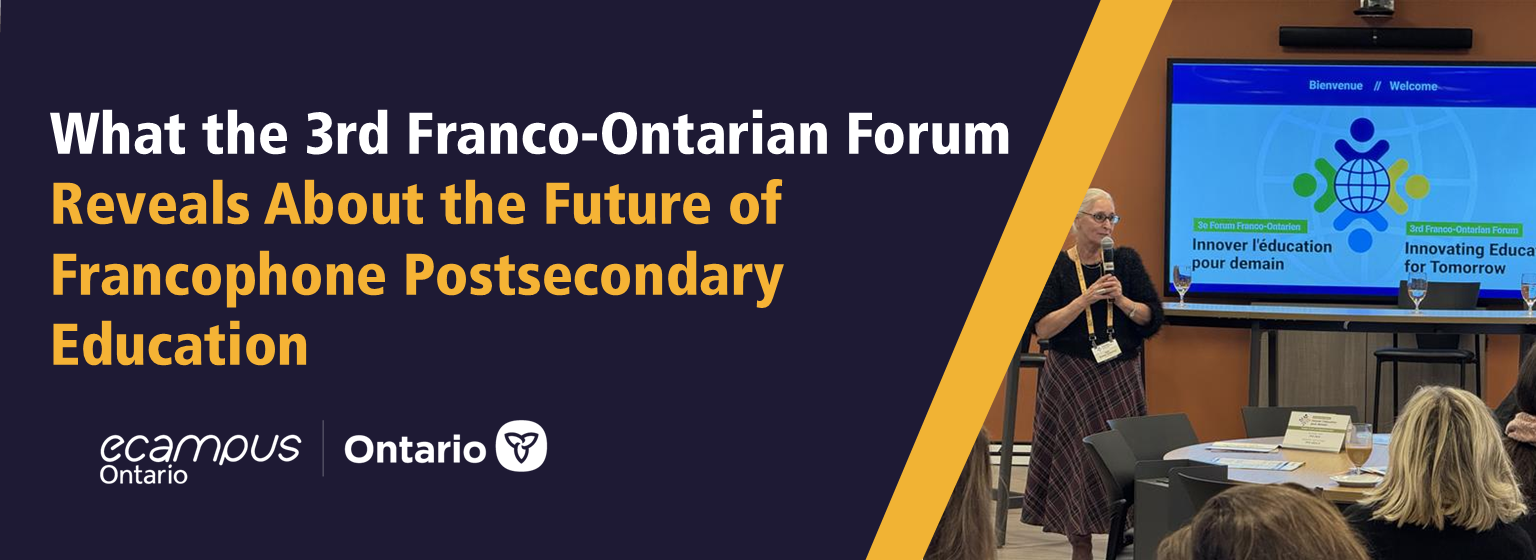
On November 18, 2025, the 3rd Franco‑Ontarian Forum was held at the INNOVA Space at the University of Ottawa under the theme Innovating Education for Tomorrow. Bringing together francophone postsecondary stakeholders — institutions, faculty, educational professionals, researchers, and partners — the event created a space to reflect on the ongoing transformations shaping French‑language education in Ontario.
Across the wide range of presentations and exchanges, a clear message emerged: the question is no longer whether the sector must change, but how to structure and sustain the changes already underway. Discussions highlighted shared concerns around digital integration, the expanding role of artificial intelligence, the evolution of required skills, and the growing need for inter‑institutional collaboration.
👉 To revisit or explore the full conversations, all recorded sessions are available on eCampusOntario’s YouTube channel:
https://www.youtube.com/playlist?list=PLZbPHTwqAgUpZQ3CxCDab_SwZ4bucFlRQ
Two keynote presentations opened the Forum, delivered by Dr. Geneviève Maheux‑Pelletier, Associate Vice‑Provost, Teaching and Learning at the Université de l’Ontario français, and Dr. Lynn Casimiro, President and CEO of Collège La Cité. Together, they offered complementary perspectives on the changes currently reshaping francophone postsecondary education.
Dr. Maheux‑Pelletier emphasized the need to adapt French‑language teaching and learning to contemporary digital realities. She underscored the importance of equipping learners with strong critical thinking skills in relation to AI and digital environments, while reaffirming that French‑language education must remain attuned to cultural and linguistic identities.
Dr. Casimiro highlighted how artificial intelligence is already transforming pedagogical and administrative practices across francophone colleges. She demonstrated AI’s potential to support inclusion, personalize learning pathways, and stimulate organizational innovation — while stressing that such shifts must be guided by thoughtful leadership and a collaborative institutional culture.
Throughout the day, forum discussions converged around three key insights. First, artificial intelligence is increasingly viewed as an essential pedagogical and operational lever, though its adoption raises concrete questions of ethics, governance, and data sovereignty. Second, technological change cannot be separated from institutional leadership capable of supporting inclusion, addressing systemic barriers, and guiding change across campuses. Third, inter‑institutional collaboration and resource sharing are emerging as crucial conditions for strengthening the ability of francophone postsecondary institutions to respond to current and future needs.
These conversations also pointed to a notable shift: educational innovation is less and less approached as a series of isolated initiatives and more as a collective effort that requires shared frameworks, common tools, and ongoing dialogue.
In his opening remarks, Robert Luke, CEO of eCampusOntario, captured this vision by noting that “we can imagine an open, innovative, bilingual, inclusive, and resilient ecosystem.” This idea reflects a central theme of the Forum: understanding francophone postsecondary education as a continually adapting ecosystem rather than a fixed model.
You can continue exploring the issues and perspectives raised during the Forum by watching the recorded sessions available on eCampusOntario’s YouTube channel:
https://www.youtube.com/playlist?list=PLZbPHTwqAgUpZQ3CxCDab_SwZ4bucFlRQ